Mirror Mirror, The Art of Non-Verbal Communication in Job Interviews
Shazaan Nadeem, MD
Feroze Mahmood, MD
Issue 3 | Volume 2 | August 2026


| First impressions | First impressions form within seconds of an interview and are driven significantly by nonverbal cues. Professionalism, and tone of voice are being interpreted before a single question is answered. |
|---|---|
| Emotional rapport | Recognise the emotional register of the interviewer, and coordinate your pace, energy, and tone to match it; subtle synchrony builds trust more than any deliberate gesture. |
| The power of the pause | The power of the pause: a brief, composed pause before answering communicates confidence. |
| Competence signalling | Competence signalling has been shown to carry more weight than warmth alone in producing favourable interview outcomes. |
Gaze averted, hands folded tight,
voice barely there, thoughts in flight.
Then, hands shaken firm, shoulders drawn back,
I stand tall, and they smile back.
The interview was over before it even started.
THE PSYCHOLOGY OF FIRST IMPRESSIONS
The impression a candidate creates in the opening moments of an interview is crucial to how the remainder of the encounter is perceived. Being fully present, achieving congruence between verbal and non-verbal signals, and offering a firm handshake are only the beginning of the conversation, interviewers, whether consciously or unconsciously, are already evaluating professionalism, appearance, movement, and tone of voice. (1)
THE SILENT OPENING MINUTE
In medical interviews, the interviewer is continuously gathering the emotional climate of the interaction. A candidate’s emotional presence is often assessed more closely than the content of the conversation itself, with interviewers drawing heavily on the non-verbal cues presented to them.
According to dual-process theory, interviewers form impressions through two distinct systems: an initial, intuitive assessment based largely on non-verbal cues, followed by a more deliberate evaluation of the candidate’s verbal responses. Candidates who project active engagement, composure, and authentic presence gain an early advantage before a single question has been answered.
One of the most persistent misconceptions among medical students and residents is that interview success depends solely on what a candidate knows or says. Research on “thin slicing” in interviews demonstrates that even a few seconds of silent behavior can meaningfully influence how a candidate is perceived. (21) In reality, interviewers have often already formed an impression of confidence, engagement, and professionalism long before the first clinical answer is complete.
Supporting this, studies published in the Journal of Applied Psychology have identified poise and the expression of positive emotion, both non-verbal factors, alongside interest, a verbal factor, as among the strongest predictors of favorable interview outcomes. (1) Grouped non-verbal cues such as body language, poise, and dress sense were shown to influence interviewer ratings alongside vocal cues including positive emotion and interest. (1)
SOMEWHERE BETWEEN WARMTH AND COMPETENCE
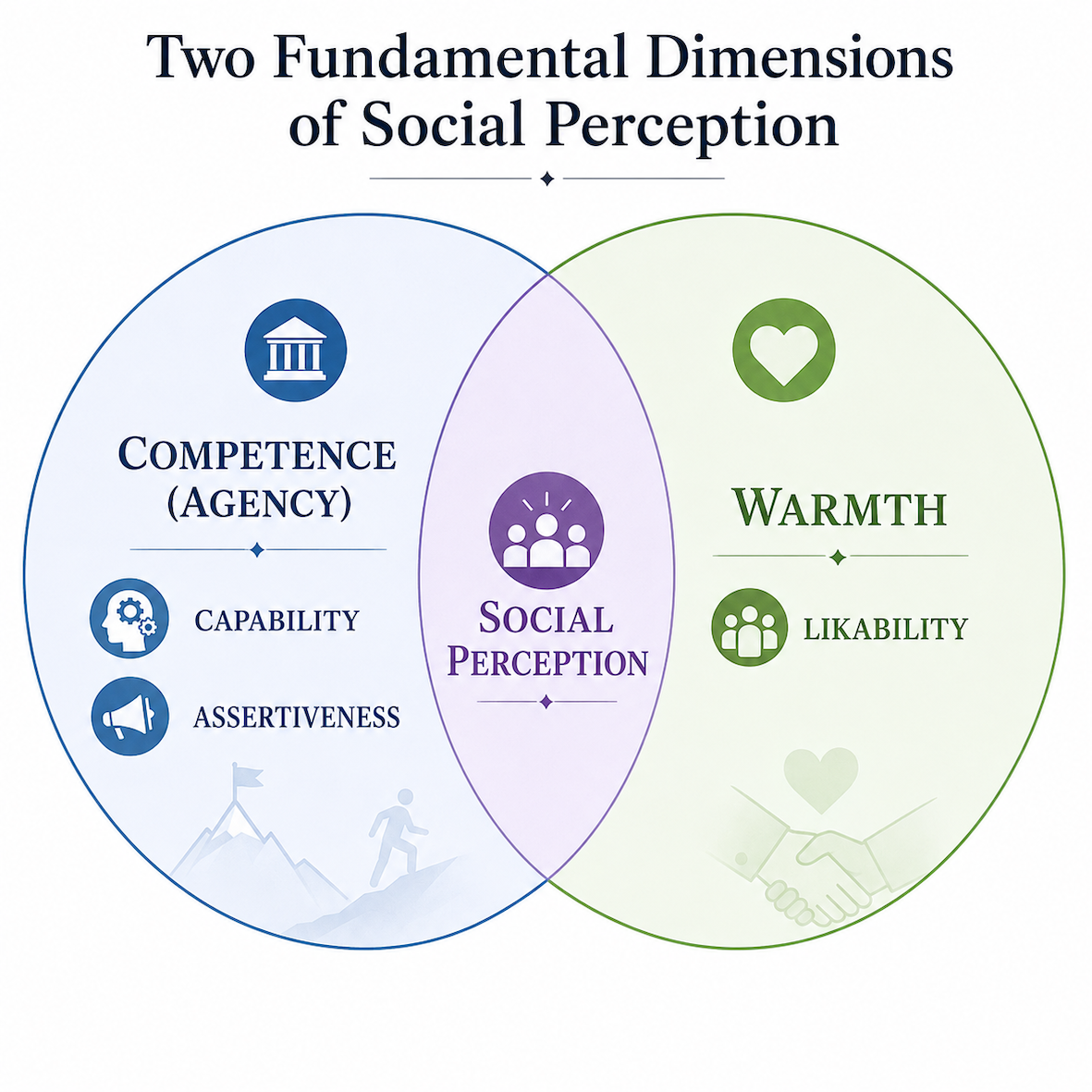
Recent studies suggest that competence conveys a stronger impression than warmth alone. (6,7) Candidates who demonstrate professional competence tend to outperform those who rely solely on friendliness. (8) It is worth asking: what does my physical presence convey? Some of the most direct evidence on this question comes from Veit et al. (2022), a cross-sectional field experiment across five European countries (N = 13,162), which found that competence signalling increased re-invitation rates, while warmth signals had minimal effect on hiring callbacks. (6)
A visual model of these two dimensions, and of how they combine to shape an interviewer’s overall impression, is provided in the figure 1.
THIN-SLICING: THE INTERVIEW BEGINS BEFORE THE FIRST ANSWER
Thin-slicing research in structured interviews further suggests that early non-verbal impressions can influence hiring recommendations, even from very brief samples of behavior. (21) Early assessments, driven largely by non-verbal cues, have been shown to be consistent with final evaluations made after the complete interview. The conclusion is that early non-verbal impressions shape how later verbal information is processed, hiring recommendations made after only a brief exposure correlate significantly with recommendations made after viewing the full interview. Verbal content, in other words, is not the whole story.
MIRRORING AND EMOTIONAL CONGRUENCE
A candidate’s emotional presence, and the rapport they build with an interviewer, plays a measurable role in establishing trust. Neuroscientific research using EEG hyper-scanning has demonstrated that inter-brain synchrony, theta-band and beta-band coupling are products of interpersonal social interaction, and they predict trust even in the absence of explicit communication. (12,14)
The value of subtle mirroring – candidates can learn to emulate the conversational rhythm of the interview. If the interviewer is calm and measured, the interviewee should also maintain a moderate speed of responses, if they lean forward to stress an important point, your own slight forward orientation would help communicate reciprocal engagement.
WHAT YOU SAY, HOW YOU SAY IT, AND WHAT’S LEFT UNSAID
Maintaining eye contact, using pauses deliberately, and establishing a natural conversational flow all help build trust and rapport with an interviewer. In Schmidt’s structured interview study, observers were given the opportunity to view only 12 seconds of silent interviewee behaviour (22), rather than the full interview. Yet, their hiring recommendations correlated significantly in the end with recommendations based on the fuller, unobserved interview. The study also found that candidates who appeared attentive, competent, confident, optimistic, and professional were more likely to receive favorable hiring recommendations. Thin-slicing means, in practice, that the interview begins before a candidate’s first answer is even finished.
DIGITAL INTERVIEWS, BALANCE OF EYE CONTACT
Research shows that professional appearance is the most important predictor of a successful interview. The appropriateness of tailoring your clothing to your organization is the single most important predictor within professional appearance (by Morrow et al.). In the age of digital interviews, it’s important to choose carefully the moments you gaze directly at the camera, particularly during opening sentence, and introductions. Other caveats would be ensuring that gestures remain within frame and taking thoughtful well-timed glances away from the screen.
Looking at the interviewer’s face helps you read them. Looking into the camera makes them experience eye contact.
Look directly at the speaker when listening, and alternate natural focus across interviewers when speaking. Studies demonstrate higher levels of gaze are rated as intelligent, decisive, and socially capable. In interpersonal psychology, direct gaze activates the mutual gaze effect, which increases perceived honesty and sincerity.
THE LISTENER IS STILL BEING INTERVIEWED
An interview is not alternating periods of speaking and waiting. You are communicating during both- even as you listen, you are being observed. The listener is still being interviewed. Demonstrating appropriate positive affect, non-verbal engagement and remaining congruent with your expressions and body language should be a priority. This should be a priority especially when the interviewer is communicating their high-leverage requirements to you.
REFERENCES
- DeGroot T, Motowidlo SJ. Why visual and vocal interview cues can affect interviewers’ judgments and predict job performance. J Appl Psychol. 1999;84(6):986-993.
- Barrick MR, Shaffer JA, DeGrassi SW. What you see may not be what you get: relationships among self-presentation tactics and ratings of interview and job performance. J Appl Psychol. 2009;94(6):1394- 1411.
- Cuddy AJC, Wilmuth CA, Yap AJ, Carney DR. Preparatory power posing affects nonverbal presence and job interview performance. J Appl Psychol. 2015;100(4):1286-1295.
- Rivera LA. Go with your gut: emotion and evaluation in job interviews. Am J Sociol. 2015;120(5):1339-1389.
- Bencharit LZ, Ho YW, Fung HH, Yeung DY, Stephens NM, Romero-Canyas R, Tsai JL. Should job applicants be excited or calm? The role of culture and ideal affect in employment settings. Emotion. 2019;19(3):377-401.
- Veit S, Arnu H, Di Stasio V, Yemane R, Coenders M. The “Big Two” in hiring discrimination: evidence from a cross-national field experiment. Pers Soc Psychol Bull. 2022;48(9):1329-1345.
- Fousiani K, Van Prooijen JW, Armenta B. Appearing competent or moral? The role of organizational goals in the evaluation of candidates. Front Psychol. 2022;13:923329.
- Dunn WS, Mount MK, Barrick MR, Ones DS. Relative importance of personality and general mental ability in managers’ judgments of applicant qualifications. J Appl Psychol. 1995;80(4):500-509.
- Fiske ST, Cuddy AJC, Glick P. Universal dimensions of social cognition: warmth and competence. Trends Cogn Sci. 2007;11(2):77-83.
- Eisenbruch AB, Krasnow MM. Why warmth matters more than competence: a new evolutionary approach. Perspect Psychol Sci. 2022;17(6):1604-1623.w
- Kraft-Todd GT, Reinero DA, Kelley JM, Heberlein AS, Baer L, Riess H. Empathic nonverbal behavior increases ratings of both warmth and competence in a medical context. PLoS One. 2017;12(5):e0177758.
- Koole SL, Tschacher W. Synchrony in psychotherapy: a review and an integrative framework for the therapeutic alliance. Front Psychol. 2016;7:862.
- Atias D, Avnor Y, Markus A, Shamay-Tsoory SG, et al. Short-term dynamic changes in interbrain synchrony during first social interaction between strangers. Neuroimage. 2026;327:121752.
- Hang Y, Wu W, Li R, Huang L, Shioiri S, He X. Trust emerges from shared attention: behavioural and neural evidence from dual EEG hyperscanning. Hum Brain Mapp. 2026;47(4):e70504.
- Hale J, Hamilton AFC. Testing the relationship between mimicry, trust and rapport in virtual reality conversations. Sci Rep. 2016;6:35722.
- Osugi T, Kawahara JI. Effects of head nodding and shaking motions on perceptions of likeability and approachability. Perception. 2018;47(1):16-29.
- Hale J, Ward JA, Buccheri F, Oliver D, Hamilton AFC. Are you on my wavelength? Interpersonal coordination in dyadic conversations. J Nonverbal Behav. 2020;44:63-83.
- Lopes PN, Salovey P, Côté S, Beers M, Petty RE. Emotion regulation abilities and the quality of social interaction. Emotion. 2011;11(4):894-902.
- Dunn JR, Schweitzer ME. Feeling and believing: the influence of emotion on trust. J Pers Soc Psychol. 2005;88(5):736-748.
- Lount RB Jr. The impact of positive mood on trust in interpersonal and intergroup interactions. J Pers Soc Psychol. 2010;98(3):420-433.
- Ambady N, Rosenthal R. Thin slices of expressive behavior as predictors of interpersonal consequences: a meta-analysis. Psychol Bull. 1992;111(2):256-274.
- Schmidt GF. The Effect of Thin-Slicing on Structured Interview Decisions [dissertation]. Tampa (FL): University of South Florida; 2010.