How to Lecture - The Science of Learning
David Benavides Zora, MD
Shazaan Nadeem, MD
Issue 3 | Volume 2 | August 2026


Premise of Lectures being Outdated
Medicine has grown remarkably sophisticated in how we manage disease, yet our teaching methods have not kept pace. We glamorize evidence-based medicine but deliver it through fifty-minute lectures and bullet-dense slides that lose most of the room before the fifth slide.
Effective Teaching Begins with the Learner
The problem isn’t PowerPoint. The problem is cognitive overload, information delivered faster than the brain can attach it to anything already there. New knowledge doesn’t land in empty space; it must connect to neurons that already exist. Until our teaching accounts for that, PowerPoint will remain the enemy of medical education, not because slides are the issue, but because we keep filling them as if the mind behind the eyes reading them has infinite bandwidth. The learner’s capacity for clinical knowledge and their baseline must be established.
Is Powerpoint a fundamental enemy of Medical Education?
There is little convincing evidence that matching a teaching style to a student’s supposed learning preference actually improves retention. What does improve retention is anchoring new material to what the learner already knows.
Residents are not empty vessels; they arrive with a foundation of prior knowledge, and the educator’s first job is to find it before adding to it.
Teaching cardiac output, for instance, works better as a question than a lecture: what do you think determines cardiac output? Relevance drives motivation, and motivation drives retention. The same approach applies to mechanical ventilation, the goal should not be to memorize ventilator settings, but to establish why those settings matter, in the context of lung injury, ARDS, and patient outcomes.
Attention Is the New Currency in Education
Today medical students can search up guidelines, watch procedural videos, or ask a large language model to explain hemodynamic physiology within seconds. What becomes a scarce resource is not the availability of information, rather, it is attention. Managing and maintaining the attention of an audience can be considered a cognitive currency, and death by PowerPoint is a real pitfall. Every crowded slide, unnecessary sentence, or competing visual trigger can overload the limited processing capacity we have. The academic educator must learn not simply how to maximize the information delivered within a 45-minute session, but how much mental processing the student can maintain. The parameters to consider include the ability to compound information as a capacity of our audience. We should continue to produce interactive learning materials and tools.
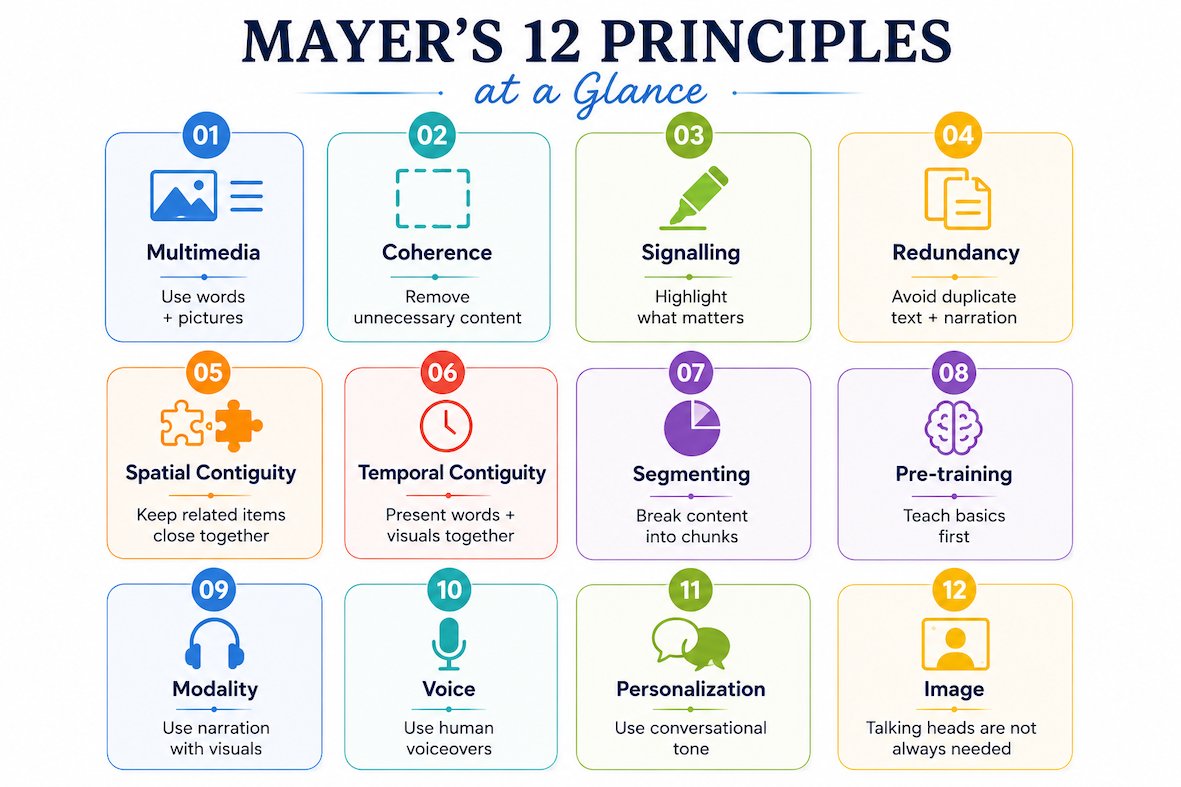
Retrieval ability is another parameter to be consistently tested within our audience, and this is something we must engage students’ actively, by testing them, on a timely interval. Recognizing that working memory is limited changes the way we present, as educators. Mayer’s Multimedia Principles answer the question we should have been asking all along. They translate learning into practical principles that can be applied to enhance individuals’ capacity for learning.
These techniques share a common purpose: they do not overwhelm the limited working memory of the student, rather, they complement learning styles.
Cognitive load can be divided into three categories: 1) Extraneous load, 2) Germane load 3) Intrinsic load. Intrinsic load is defined as the complex nature of the subject itself. Extraneous load, is the mental heavy-lifting the student has to do through irrelevant or competing slide design. Germane load, finally is the effort the student spends on making active connections between different subject matter.
Elimination and exercising an awareness of redundancy–> If something on the slide isn’t meaningfully contributing to the student’s understanding of it, simply remove it.
Repetition and integration are necessary to consolidate information. The major enemy of student learning is: extraneous cognitive load.
Mayer’s Principles of Learning
Mayer’s principles of learning include temporal contiguity, which suggests that audio and visual learning should not be competing, rather, complementary.
The slide becomes visual support; the lecturer becomes the vessel for explanation. The audio is the gift, the visual design is the ribbon tying it together.
The Importance of Foundational Knowledge and Clinical Context
Foundational knowledge matters because clinical teaching becomes far more powerful when new experiences can attach to existing knowledge. Something learned theoretically may suddenly become meaningful when encountered in the OR and given a clinical context. It is important to provide clinical relevance to each slide, and real-world application of the medical information you are teaching.
Practical Tips
The educator’s value lies not only in delivering the most substantial information, but in managing the attention of the student the same way one manages currency. Directing attention is an art, and Educators must learn to understand what is the currency of education? Attention = cogntive currency.
Mayer’s principles of learning incorporate the use of temporal contiguity, which underscores how important it is to space visual and auditory cues together when teaching. The use of such tools, synthesizing coherent and concise information, provides the best foundation for learning.
Following this, context development and the opportunity for further challenging ‘thought exercises’ would increase educational efforts. Prompting a thought process is more valuable than regurgitation of facts at your audience.
Conclusion: The Lecture Is Not Outdated but the Way We Lecture Is
Perhaps the question, then, is not “Are lectures outdated?” but “Have we updated the way we lecture?” As educators at some of the top institutions in the world, we have a platform designed to enrich students’ lives and expand their thinking.
In conclusion, while we have the tools to enable meaningful learning.
It is simply our duty to apply them.
REFERENCES
- Sweller J. Cognitive load during problem solving: effects on learning. Cogn Sci. 1988;12(2):257-285.
- Ausubel DP. Educational Psychology: A Cognitive View. New York, NY: Holt, Rinehart and Winston; 1968.
- Pashler H, McDaniel M, Rohrer D, Bjork R. Learning styles: concepts and evidence. Psychol Sci Public Interest. 2008;9(3):105-119.
- van Merriënboer JJG, Sweller J. Cognitive load theory in health professional education: design principles and strategies. Med Educ. 2010;44(1):85-93.
- Roediger HL 3rd, Karpicke JD. The power of testing memory: basic research and implications for educational practice. Perspect Psychol Sci. 2006;1(3):181-210.
- Mayer RE, Moreno R. Nine ways to reduce cognitive load in multimedia learning. Educ Psychol. 2003;38(1):43-52.
- Mayer RE. Cognitive theory of multimedia learning. In: Mayer RE, ed. The Cambridge Handbook of Multimedia Learning. 2nd ed. New York, NY: Cambridge University Press; 2014:43-71.