From Lecture Hall to Game stations: Reimagining Anesthesia Grand Rounds
Federico Puerta-Martinez, MD, MMSc,
Nadav Levy, MD, MHQS
Special contribution from Yitzhak Sinai Brzezinski, Yunping Li, Phil Hess, Aviva Green
Issue 3 | Volume 2 | August 2026


Introduction
Grand rounds are an important part of departmental education, but the traditional lecture format does not always create opportunities for active participation, teamwork, or application of clinical concepts. With this challenge in mind, our department developed a game-based obstetric anesthesia workshop that transformed a regular grand rounds session into a series of interactive learning stations.
The workshop had two complementary goals. First, it provided an interactive review of obstetric anesthesia topics relevant not only to clinicians who regularly practice obstetric anesthesia, but also to anesthesiologists who may encounter pregnant patients in non-obstetric perioperative settings. Second, it introduced game-based learning as an educational strategy that could be adapted to other anesthesia topics.
Rather than replacing educational content with entertainment, the design team used game mechanics to create structured opportunities for discussion, prioritization, clinical reasoning, and teamwork.
Designing the Workshop
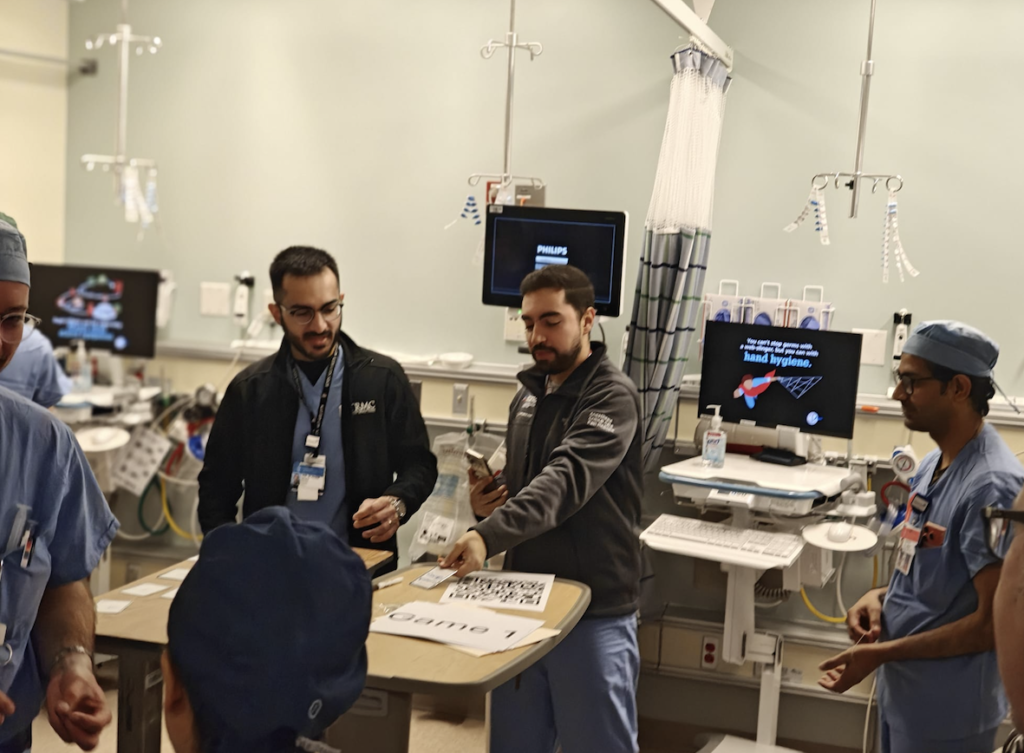
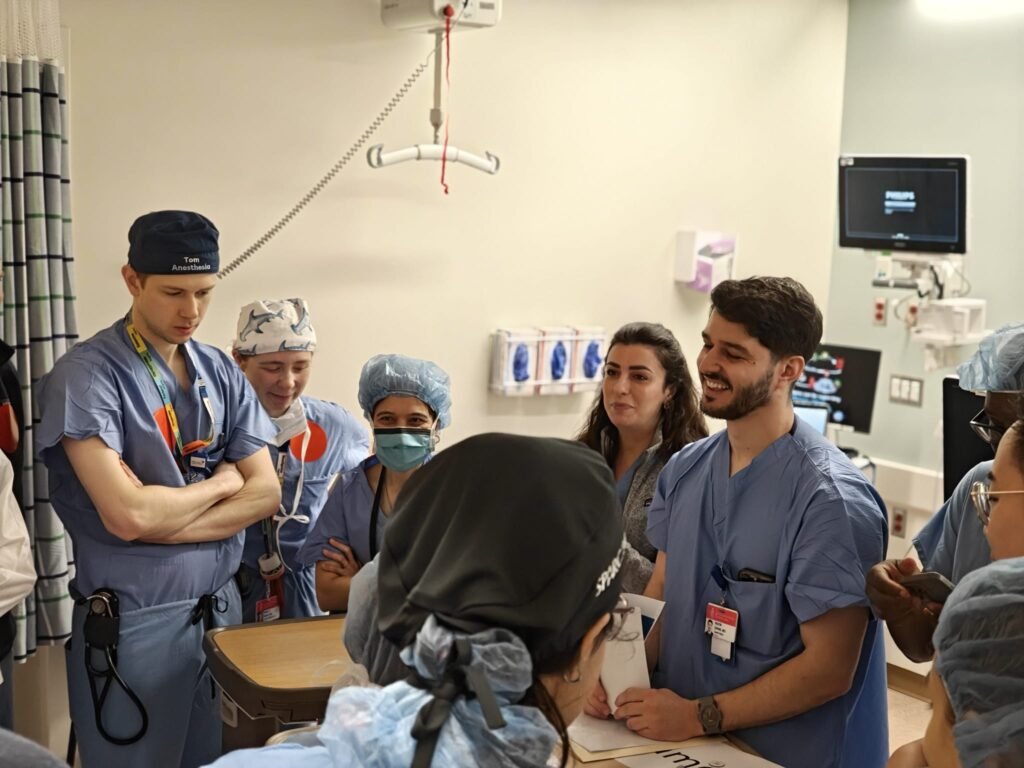
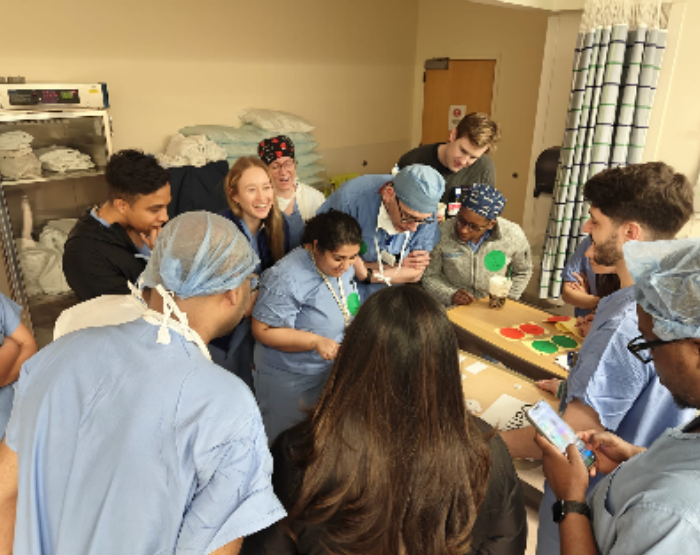
The session consisted of four stations focused on crisis resource management, point-of-care ultrasound, anesthesia for non-obstetric surgery during pregnancy, and thromboelastography. Small groups rotated through each station, working in teams and participating in a facilitated debrief before moving to the next activity.
The design process began by identifying what participants should think about or do at each station. The team then selected a game format that required learners to practice that same type of reasoning. This approach, often described as constructive alignment, helped ensure that the game mechanics supported the educational objective rather than distracting from it.
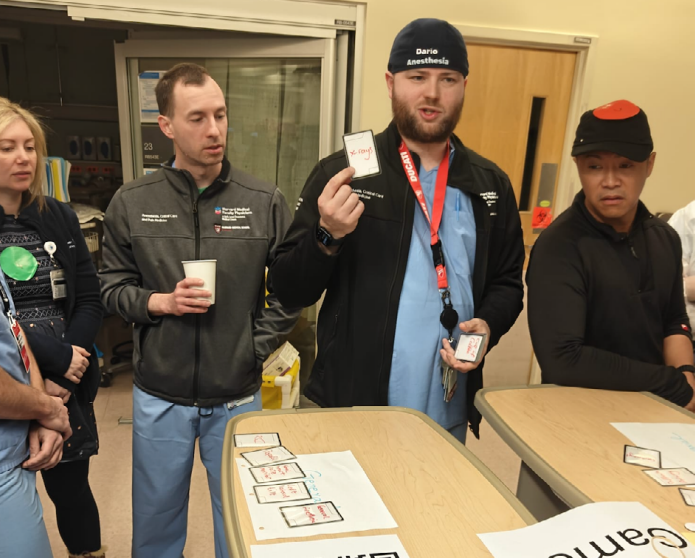
For example, the anesthesia-in-pregnancy station used a structured debate. Participants considered a clinical scenario involving a pregnant patient requiring orthopedic surgery and were assigned to defend either general or neuraxial anesthesia. Teams selected cards representing factors such as aspiration risk, airway changes, uteroplacental perfusion, positioning, and fetal considerations. They then used those cards to organize their arguments and respond to the opposing team.
The purpose was not to identify a single correct technique. Instead, the activity required participants to prioritize competing considerations, explain the reasoning behind their choices, and consider a perspective they might not initially have selected.
The crisis resource management station used charades to explore nontechnical skills. Participants enacted concepts such as leadership, workload distribution, situational awareness, and effective communication while their teammates attempted to identify the behavior. The subsequent debrief connected these sometimes-abstract concepts to observable actions during routine care and clinical crises.
The point-of-care ultrasound station used a matching activity in which teams paired clinical indications with relevant ultrasound applications. The thromboelastography station combined tracing interpretation, visual pattern recognition, and treatment selection through a case-based matching exercise.
Each activity was intentionally different. Some stations emphasized clinical reasoning, while others focused more on recognition, communication, or teamwork. Together, they illustrated that game-based learning is not a single teaching method, but a broad set of approaches that can be adapted to different educational objectives.
Making a Large-Group Workshop Work
Delivering a multi-station workshop during grand rounds required more logistical preparation than a conventional lecture. The workshop was held in the PACU during the existing protected educational block on Wednesday mornings.
Participants were assigned to groups upon arrival and identified by colored team stickers. For late arrivals, the team planned an additional group that could rotate at shorter intervals until joining the main schedule.
Each station was supported by clinical content expertise and experience with education or simulation. Before the workshop, facilitators reviewed the learning objectives, rules, station timing, debriefing prompts, and key teaching points. This preparation was important because differences in instructions or timing could substantially change the experience from one group to another.
Although our workshop used separate content experts and game facilitators, this structure is not required for every setting. In a smaller group, one appropriately prepared individual could perform both roles if they are comfortable with the clinical content, game mechanics, and debriefing process.
Most materials were inexpensive and produced locally, including printed cards, visual aids, clinical scenarios, and team identifiers. This reduced reliance on specialized technology and made it easier to modify the activities during development.
The Central Role of Debriefing
One of the most important lessons from the workshop was that the educational value did not come from gameplay alone. The debriefing transformed the activity into a learning experience.
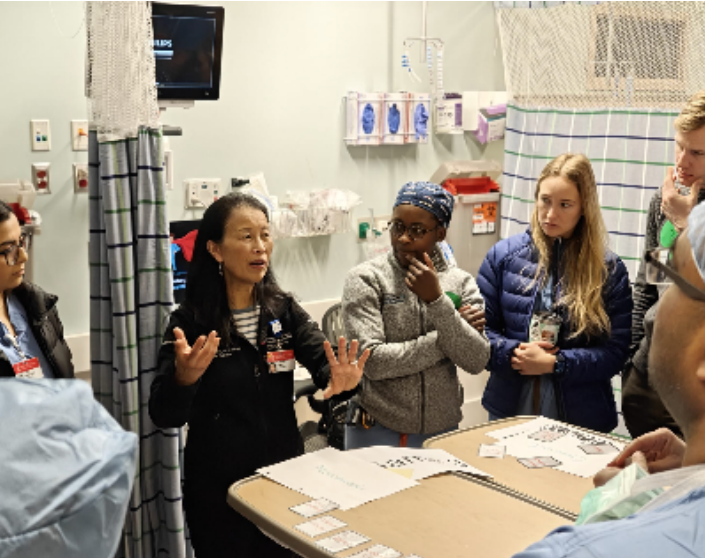
Each station included predetermined prompts and a small number of take-home points. Facilitators used the debrief to clarify misconceptions, explain the clinical rationale behind the activity, and connect the game experience to practice.
Time management was therefore critical. When gameplay continued longer than planned, debriefing was the component most at risk of being shortened. Future implementations should protect debriefing time explicitly, even if that requires simplifying the rules, reducing the number of rounds, or ending gameplay before every item has been completed.
Practical Lessons for Future Sessions
Several principles may help other departments considering a similar format.
Game mechanics should be selected only after the educational objective is clear. A competitive activity may encourage participation, but participation alone does not guarantee meaningful learning. Activities intended to support clinical reasoning should require learners to prioritize information, justify decisions, or apply concepts to a scenario.
Audience heterogeneity should also be anticipated. Grand rounds may include junior trainees, senior faculty, subspecialists, and clinicians with limited exposure to the topic. Accessible rules, mixed-experience teams, and facilitator-guided debriefing can help support participation across different levels of experience.
Finally, game-based learning should not be viewed as inherently superior to lectures. It requires additional preparation, coordination, and human resources, and competition may not appeal equally to all learners. The format should be selected when its interactive elements meaningfully support the educational goal.
Looking Ahead
This workshop demonstrated how a conventional grand rounds period could be reorganized into an active, teambased educational experience, when deemed beneficial. Educationally, the most transferable lessons were not related to any single game, but to the design process: align the activity with the objective, prepare facilitators carefully, anticipate logistical challenges, and protect time for debriefing.
The approach may be adapted to other anesthesia subspecialties, particularly when the educational goals involve discussion, prioritization, communication, or clinical decision-making. Future sessions can also incorporate more formal assessments of learning and compare game-based formats with traditional instructional approaches.
Disclosure: A detailed peer-reviewed report of this educational initiative has been accepted for publication in the International Journal of Obstetric Anesthesia. This internal article is intended as an educational and departmental feature.
REFERENCES
- Xu M, Luo Y, Zhang Y, Xia R, Qian H, Zou X. Game-based learning in medical education. Front Public Health. 2023;11:1113682. doi:10.3389/fpubh.2023.1113682.
- van Gaalen AEJ, Brouwer J, Schönrock-Adema J, Bouwkamp-Timmer T, Jaarsma ADC, Georgiadis JR. Gamification of health professions education: a systematic review. Adv Health Sci Educ Theory Pract. 2021;26(2):683- 711. doi:10.1007/s10459-020-10000-3.
- Gilic F, Dalgarno N, Simpson MTW. Applying constructive alignment and cognitive load in teaching. Can Fam Physician. 2022;68(4):308-310. doi:10.46747/cfp.6804308.
- Bak BM, Grate JC, Ramanujan K, Huang J. Escape Boxes: A Serious Game for Teaching Nontechnical Skills Pertinent to Crisis Management. J Educ Perioper Med JEPM. 2025;27(3):E751. doi:10.46374/VolXXVII_Issue3_Huang.
- Lee A, Goodman S, Chen CM, Landau R, Chatterji M. Electronic Feedback Alone Versus Electronic Feedback Plus in-Person Debriefing for a Serious Game Designed to Teach Novice Anesthesiology Residents to Perform General Anesthesia for Cesarean Delivery: Randomized Controlled Trial. JMIR Serious Games. 2024;12:e59047. doi:10.2196/59047