The Gibbon-IBM Heart-Lung Machine: Cardiac Surgery’s Pioneering Instrument
Noor-E-Saher Ahmed
Mansi Arora, MD
Issue 3 | Volume 2 | August 2026


“The surgeon who would attempt to suture a wound of the heart should lose the respect of his colleagues.” — Theodor Billroth, 1881 (The Father of Modern Surgery)
As recently as the mid twentieth century, the heart was considered a forbidden zone for surgeons, as there were incredible challenges considered insurmountable for open heart surgery. Most patients with significant congenital heart disease died without treatment.
A key figure in the story of how cardiac surgery became possible was Dr. John H. Gibbon Jr., who was called to action after witnessing a patient die from severe heart failure. This propelled him to invent one of the most fascinating pieces of machinery, the Cardio Pulmonary Bypass Machine (CPB).
CPB is a procedure in which crucial functions of the heart and lungs are temporarily replaced by a bypass machine: the Heart Lung Machine (H L Machine). Essentially, it replicates the process of taking deoxygenated venous blood, reoxygenating it to “red” blood, and pumping it into the arterial system, ensuring the cycle of oxygen renewal and delivery. This is done by placing cannulas in major venous channels or chambers of the heart (such as the superior vena cava, inferior vena cava, and the right atrium), collecting the venous blood into a reservoir, which goes through an oxygenator that exchanges carbon dioxide for oxygen. The newly oxygenated blood returns to circulate the body via an arterial cannula inserted in the aorta, completing the CPB circuit. (1) This process, now commonly used in cardiac operating rooms, has been considered one of the most important developments in the history of medicine, as it allowed physicians to operate directly on the heart and major vessels for the first time. Thus, a new era of essential, life saving procedures was born.
Gibbon started developing the heart lung machine after he observed a woman dying from complications due to a massive pulmonary embolism during his research fellowship at Boston’s Massachusetts General Hospital in October 1930. He realized that had her venous blood been removed, oxygenated, then returned to the arterial system, the woman could have been saved. (2) Yet, no technology present at the time could perform such a feat. So, Gibbon — with the help of his attending, Dr. Edward D. Churchill, his wife, Mary Gibbon, and the International Business Machines Corporation (IBM) — spent the next 23 years innovating a solution. (3) Gibbon and his wife returned to his hometown of Philadelphia in 1935, where he joined a surgical staff team at the University of Pennsylvania and continued his research on CPB. For such a revolutionary invention, Gibbon and his colleagues made rapid progress. By 1939, a functional heart lung machine had been built, and Gibbon observed that it was able to support cats on heart paralyzing medicine — or cardioplegia — for around 117 minutes. Cats under 10 to 20 minutes of CPB achieved long term survival post surgery. The eruption of the Second World War halted Gibbon’s project, whereafter he joined the Army Medical Corps. He served two years on the Pacific Front, then two years at Galesburg Military Hospital in Illinois. Once the war ended in 1945, Gibbon resumed his work at his alma mater, Philadelphia’s Jefferson Medical College. By 1952, he developed an H L machine that could support humans, known now as the Gibbon IBM Heart Lung Machine Model II. (2)
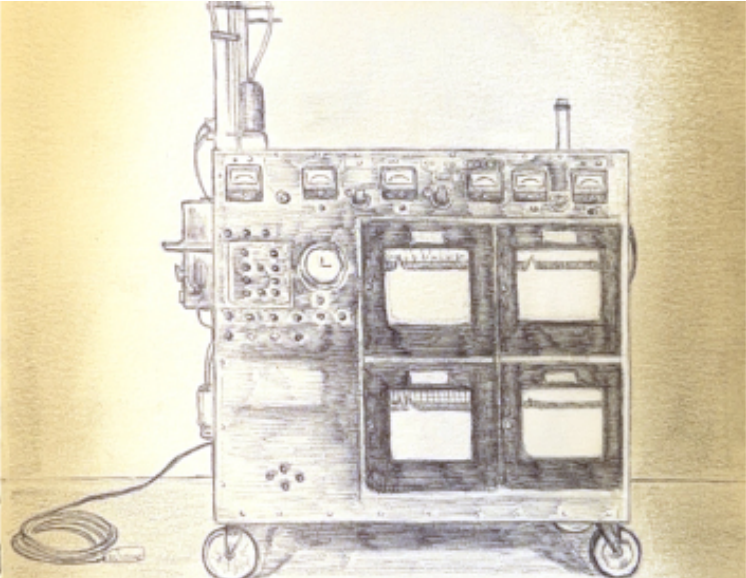
The original photographs of the Model II visualize its complex, equipment heavy design. It was a stainless steel, box shaped machine that weighed slightly over one ton. One side of the machine had six small screens lined up on top and four larger ones below them, stacked together in rows of two. Under these screens were knobs used to adjust multiple components within the machine. With it came three DeBakey pumps. Essentially, these pumps are comprised of tubing and a roller within a chamber. The roller compressed the tubing as it rotated in order to propel blood forward and provide its flow to the body. (4,5) The main component that allowed the Model II to support humans was its vertical oxygenator. The oxygenator, with small screens at the top left of the rectangular prism, was encased with steel sheets that stretched 25 centimeters tall and 40 centimeters wide. In those six sheets, blood would flow down each side, providing a surface for the fluid to be exposed to oxygen — less than the gas exchange surface of a normal lung, but enough to supply 100 percent of the oxygen saturation needed. As suggested by its name, its purpose was to provide an adequate amount of oxygen in exchange for carbon dioxide in the blood. This part of the machine, paired with
the DeBakey pumps, was the most essential in replicating the physiological process by which the heart and lungs
respire. (6,7)
In addition to these parts, the Model II included numerous safety features. Electronic devices within the machine constantly monitored the circulating blood’s volume and pH. The venous pump’s flow would automatically increase or decrease depending on the amount of blood in the reservoir. Moreover, since inflammable anesthetic was used during operations, the machine held cabinets filled with copious amounts of nitrogen. A backup generator battery was also included in the event of a power outage. (7)
Gibbon tested the Model II on dogs until their post operative survival rate reached 90 percent. After that threshold was reached, he shifted his experiments to humans. (6)
May 6, 1953 marked the day of the first successful cardiopulmonary bypass operation. Cecilia Bavolek, an 18 year old patient, underwent an atrial septal defect (ASD) repair. After 26 minutes of full asystolic bypass (meaning the patient’s heart was completely stopped) and 45 minutes total of CPB, the atrial hole was sewn closed. The procedure was risky, intense, expensive, and almost disastrous. The team encountered a significant issue: blood clots.
For every 500 mL of blood, only 10 mg of heparin was used. Consequently, the oxygen saturation fell, and blood began to clot on the oxygenator as Gibbon prepared to close the defect. The decision was made to seal the ASD as quickly as possible with a continuous suture rather than a pericardial patch so that Bavolek could be taken off bypass immediately. Gibbon’s team still managed to make this monumental breakthrough work, and Bavolek made a full and “uneventful” recovery post op. However, the surgery was unsuccessful on the next two patients: one died of cardiac arrest, and the other of severe blood loss alongside a separate, undiagnosed septal defect. Anthony Dobell, a resident under Dr. Gibbon, stated that these deaths were, in part, attributable to a lack of expertise in anesthesia and pediatric cardiology — essentially, human factors resulting from an inadequately prepared, competent team. Six other teams between 1952 and 1954 attempted open heart surgery using the new H L machine, but unfortunately only one procedure was successful. This instilled hopelessness in Gibbon, who declared a cease in the use of his creation even though the causes of these losses were misdiagnoses and technical issues. (2)
Dr. Gibbon’s invention, despite his later pessimism about its efficacy, became the eventual blueprint for the modern heart lung machine. Physicians essential to the history of CPB, such as John Kirklin of the Mayo Clinic, saw its potential and expanded upon it, recognizing the Model II for its worth and combining it with Dr. Walter Lillehei of the University of Minnesota’s essential work on cross circulation. The failures that occurred after its first success not only led to improvements in the machine itself but also pioneered the field of cardiovascular perfusion. Furthermore, the expansion of cardiac anesthesia research became crucial to eliminating errors during these procedures. As these aspects progressed in efficiency and safety, the heart lung machine was increasingly integrated into cardiac surgery. Today, the modern version of the instrument is an essential tool used daily for a wide range of complex cardiac repairs, from atrial and ventricular septal defect repair, to coronary artery bypass grafting, general valve repair, and groundbreaking heart transplantation surgery. None of it could have been possible without the ability to perform CPB. (8)
A precedent was set by the Gibbon IBM Heart Lung Machine Model II, as it fundamentally engineered the way open heart surgery would be safely performed. Despite its successes and failures, physicians sought to utilize its technology, acknowledging that, risks aside, the tool could be refined. Now, multiple times a day, skilled teams of surgeons, anesthesiologists, perfusionists, nurses, and physician assistants work cohesively alongside the H L machine to achieve what was only recently considered impossible.
REFERENCES
- Abdelhadi I, Semiens G, Sharma S, et al. Cardiopulmonary Bypass. StatPearls Publishing; 2024 Aug 12.
- Hessel EA. A Brief History of Cardiopulmonary Bypass. Semin Cardiothorac Vasc Anesth. 2014;18(2):87-100.
- Gibbon JH Jr. Double Portrait [photograph]. 1963. Thomas Jefferson University Archives & Special Collections.
- Gibbon JH Jr. Heart-Lung Machine [photograph]. 1953. Thomas Jefferson University Archives & Special Collections.
- DeBakey M. A Simple Continuous-Flow Blood Transfusion Instrument. New Orleans Med Surg J. 1934;87(6):386-389.
- Stoney WS. Evolution of Cardiopulmonary Bypass. Circulation. 2009;119(21):2844-2853.
- Gibbon JH. Application of a Mechanical Heart and Lung Apparatus to Cardiac Surgery. Arch Surg. 1937;34(6):1105-1131.
- Passaroni AC, Silva MAM, Yoshida WB. Cardiopulmonary Bypass: Development of John Gibbon’s Heart-Lung Machine. Rev Bras Cir Cardiovasc. 2015;30(2).